Madrid Tops Spain’s PISA Rankings, But Nobody’s Really Winning
Spain’s richest students fell twice as hard as its poorest ones. Nobody’s actually talking about this part. Spain has just posted its worst Spain PISA results in history, across reading, maths and science, and buried inside that is the detail that Madrid actually topped the regional table. That’s not the win it sounds like. Here’s what the data shows, and what it means if you’re choosing a school in Spain.
I’ve put together a video walking you through what these PISA results actually mean — watch it here. If you’d like more detail, read on below.
What PISA actually measures
PISA is the OECD’s global test. It’s run every three years and sat by 15 and 16 year olds in around 90 countries. It tests whether children can actually use what they know, not just recall it from memory. As a rough guide, the OECD reckons that about 20 points on the scale is roughly a full school year of learning.
The richest students fell twice as hard
Spain’s most advantaged students lost 33 points in reading since 2022, against 15 points for the most disadvantaged. That’s more than twice the fall. The gap between the most advantaged and least advantaged is actually shrinking, which sounds like good news, but it isn’t, because nobody caught up. The top just came down closer to the bottom. That’s not equality. It’s everybody moving downwards together.
Where Madrid fits into the Spain PISA results
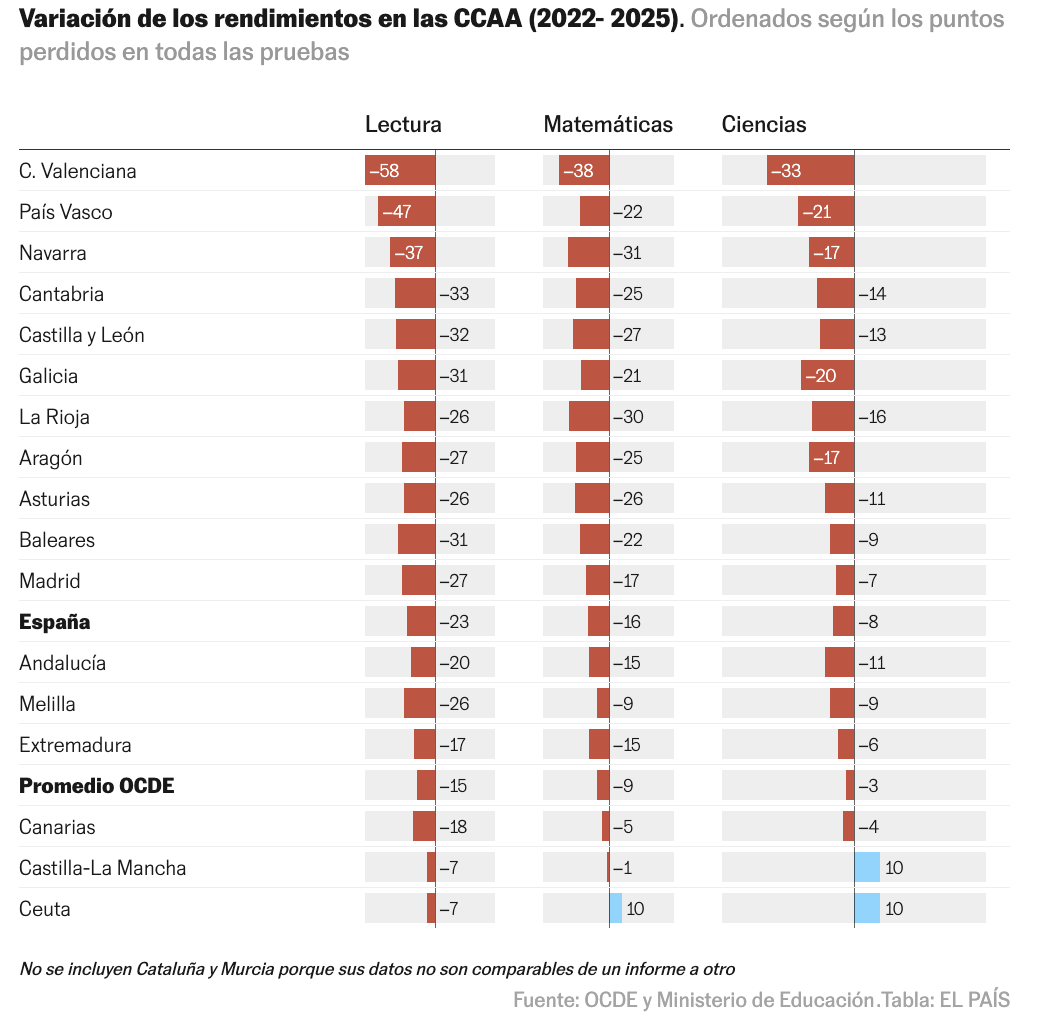
Madrid topped Spain in maths and science this year, the first time that’s happened since 2012. It’s the region with the highest GDP per capita in Spain, so this isn’t something to be thumping our chests about. Madrid lost 27 points in reading, 17 in maths and 7 in science compared with the last report. It only holds the top spot because all of the other comunidades fell by more. So it’s not a win, although we can feel a little bit better about it.
Myth: this is a public school problem
It isn’t. The data covers public, concertado (Spain’s semi-private, partly state-funded model) and private schools. Every single student is in the sample.
Myth: Are teens just lazier now?
No. But there are specific skills that are slipping: attention, reading, working through complexity, and focus. There’s another question underneath that too. What we had when we were growing up was you study hard, you get a good job, you buy a house. Does that still hold for today’s teenagers? Not really, and that’s driving what motivates them to study hard in the first place.
What’s actually driving the fall
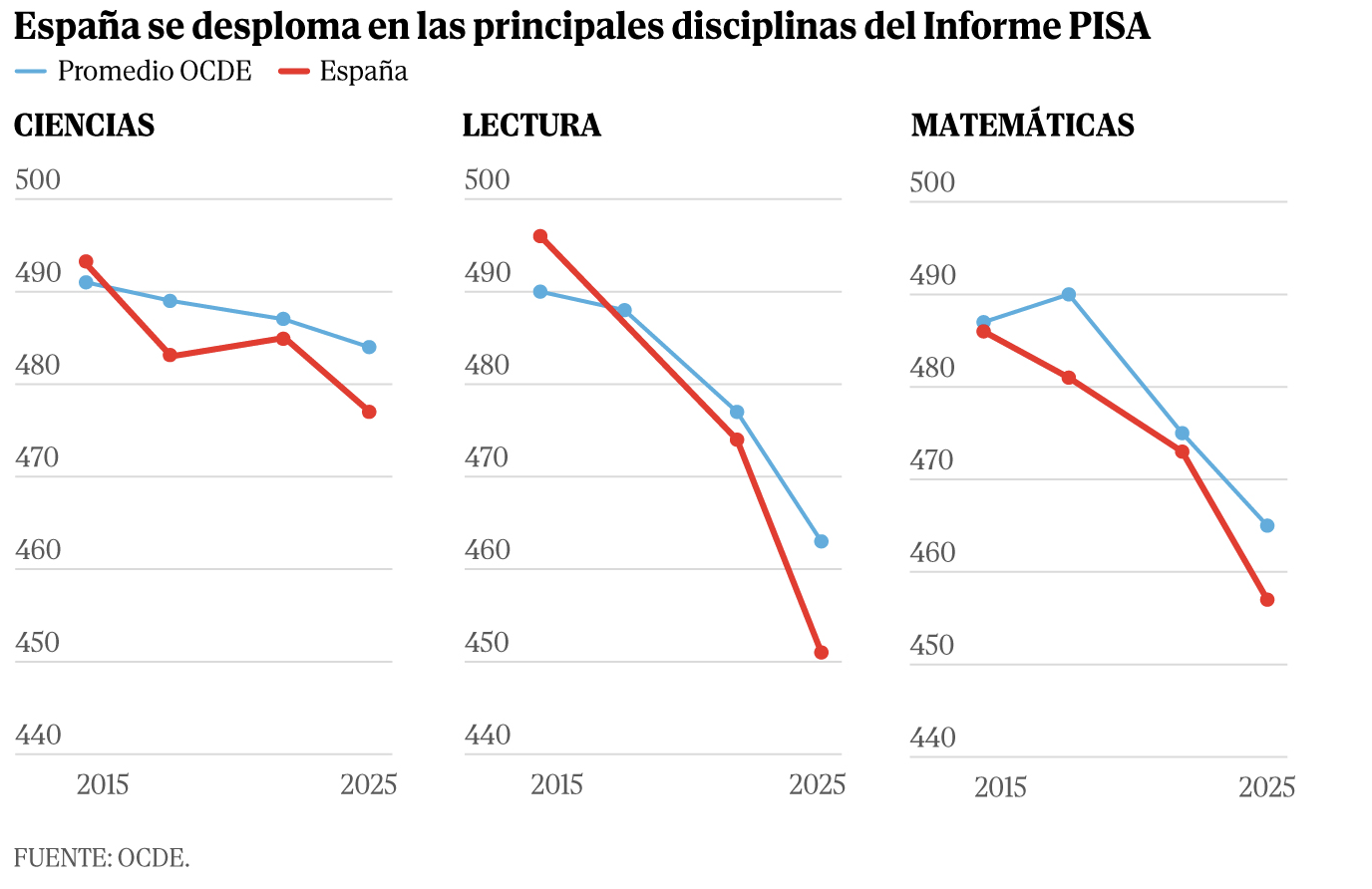
It’s not a lack of resources, but it does seem to be a lack of attention. The OECD’s own analysis names it directly: sustained focus is slipping. It rules out the exam changing, phone bans, or immigration as the explanation, even though those are the ones usually cited.
Parental engagement is down too: 69% of Spanish students say their parents ask them weekly what they did at school, against 77% three years ago. And there’s less reading for pleasure across every single age.
How Spain compares to the rest of Europe
Most countries fell this cycle. It’s a global trend, but that doesn’t make us feel any better. England actually rose in science and held flat in reading and maths this time around. Spain is roughly two school years behind England in both reading and science. Spain is also spread across 17 different comunidades, with quite a big divide between them, similar to the gap you’d see between England and Wales or Northern Ireland.
What this year’s Spain PISA results mean for parents choosing a school
A regional ranking doesn’t tell you how a specific school handles reading, screens, or its own use of AI in the classroom, and those are the things that actually affect your child. It’s why I talk about finding the right school for your child, not the best-ranked region. Ethos, class size, language provision and how a school actually teaches matter more than where its comunidad landed in a table.
What parents can do
Getting children to read can be a challenge, especially with a screen thrown into the mix. If a child’s on a screen, there’s almost no reading happening at home either. And quite a lot of schools I visit don’t even have libraries. Many gave up the library space during the pandemic, and it hasn’t come back since. As parents, we have to keep pushing for our children to read, because we can’t fall back on schools to do it for us.
What schools need to do
Spanish kids use AI for homework well above the OECD average, as do other top-performing school systems, like Singapore. So the problem isn’t using AI. It’s not having a plan for how to use it: clear rules by task, whether it should be used to check work rather than do all the thinking. Teachers need to be trained up on this too, and they’re already overworked and underpaid. And it needs political agreement, one agreement between all political parties, because it’s not something one party alone can fix.
Frequently Asked Questions
What do the 2025 Spain PISA results show? Spain recorded its worst historical results in reading, maths and science. The richest students lost more ground than the poorest, and Madrid topped the regional table despite falling in all three subjects itself.
Did the richest students really lose more ground than the poorest? Yes. Spain’s most advantaged students lost 33 points in reading since 2022, more than double the 15-point drop among the most disadvantaged. The gap is narrowing only because everyone fell, not because anyone caught up.
Why did Madrid top Spain’s table if its scores also fell? Madrid lost 27 points in reading, 17 in maths and 7 in science compared with the previous report. It only holds the top spot because every other comunidad fell by more.
Is the fall in PISA scores because teenagers are less intelligent? No. There are specific skills slipping, particularly attention, reading and working through complexity, rather than a drop in intelligence.
How does Spain compare to the rest of Europe on PISA? Spain is roughly two school years behind England in reading and science. Spain’s 17 comunidades vary considerably, similar to the spread seen across the UK’s nations.
Getting the right school, not just the top-ranked region
A regional PISA ranking is a useful headline, but it isn’t a reason to choose one school over another.
Steps into Spain helps families from all over the world find the right school for their child and navigate the Spanish admissions process. Get in touch via stepsintospain.es or book your free call to get started.